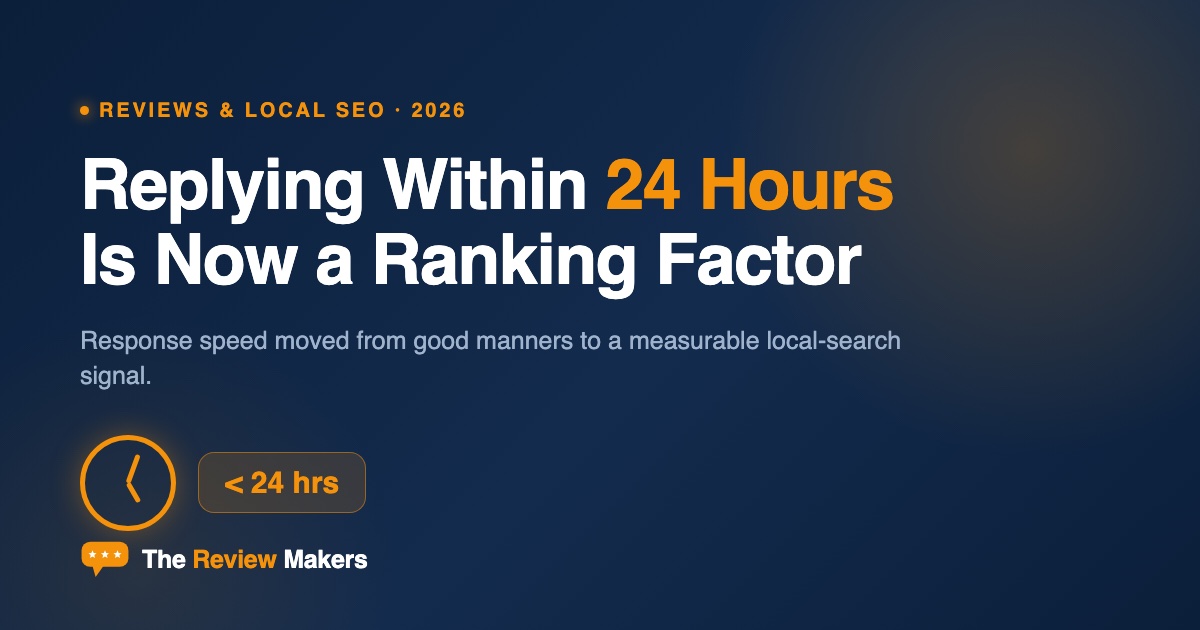
Short version. Replying to reviews used to be good manners. In 2026 it’s a measurable ranking signal — and speed is the part most businesses get wrong. Businesses that respond within 24 hours rank noticeably higher in the local pack, customers now expect a next-day reply, and a fast response to a bad review can literally turn a 1-star into a 4-star. Here’s what changed and how to keep up without living in your inbox.
For years, the advice was simple: get more reviews. Volume and average rating were the whole game. But Google’s local algorithm has quietly shifted toward something harder to fake — engagement. Not just how many reviews you have, but whether you’re actually there, responding, and how quickly. And the data in 2026 makes the case hard to ignore.
Why speed became a signal
Google has never published a line that says “reply within 24 hours and rank higher.” It doesn’t work like that. But Moz’s long-running Local Search Ranking Factors study has consistently listed review response activity as a genuine local ranking factor — and the reasoning is straightforward.
A business that responds quickly and consistently looks alive. It signals an owner who is present, an operation that’s running, and a profile worth surfacing to searchers. Stale profiles — no replies, questions left hanging — look abandoned, and Google is cautious about recommending places that might have closed or stopped caring. On top of that, your replies are indexable text: a thoughtful response that naturally mentions your service and city adds relevance signals the review itself may not contain.
That’s why the 2026 benchmark data lines up so cleanly: businesses replying within a day sat about 1.6 positions higher in the local pack than those taking a week, and those answering 75%+ of reviews ranked 2.3 positions higher on average. In the map pack, where only three results show, moving up two spots is the difference between being seen and being invisible.
A slow reply isn’t just bad service anymore. It’s a signal — to the customer and to Google — that nobody’s home.
— The Review Makers
Customers moved the goalposts too
The algorithm isn’t the only thing that got faster — expectations did. BrightLocal’s 2026 data shows 32% of consumers now expect a response by the next day, nearly double the 18% who said so in 2025. Same-day expectations tripled in a single year, from 6% to 19%.
Think about what a prospective customer sees when they read your reviews. A recent negative review sitting there for three weeks with no reply tells them exactly what to expect if they have a problem: silence. A reply posted the next day — calm, specific, human — tells them the opposite. The reply is often read by more people than the review it answers.
The negative-review clock is the one that really matters
If you only move fast on one thing, make it the bad reviews. The window to change the outcome is short and real: a negative review that gets a response within 4 hours is 3× more likely to end with the customer updating their rating than one answered after 48 hours. Respond fast, resolve the issue offline, and a 1-star can quietly become a 4-star.
The compounding effect is significant. Businesses that consistently respond to negative reviews recover a meaningful share of otherwise-lost customers and tend to see their overall rating drift upward over the following year — not because the bad reviews disappear, but because the response pattern earns back trust and prompts revisions.
How to actually hit a 24-hour reply time
The goal isn’t to refresh your profile all day. It’s a system that guarantees nothing sits unanswered for more than a day:
- Turn on instant alerts. A new-review notification to your phone or email is the whole battle. You can’t reply in 24 hours to something you find out about in three weeks.
- Prioritise by heat. Negative and low-star reviews first (aim for hours, not days), then neutral, then positive. Don’t let a 1-star wait while you thank five 5-stars.
- Keep responses specific, not canned. Google and readers can both smell copy-paste. Reference the actual situation, use the customer’s name, and mention what you do and where — naturally.
- Never argue publicly. Acknowledge, apologise where fair, and move the detail offline (“please email us so we can make this right”). The public reply is for the thousand people reading, not just the one who complained.
- Batch the easy ones. Set a daily 10-minute slot to clear positive and neutral replies so your response rate stays above that 75% threshold.
- Speed up drafting. Our free [Review Response Generator](https://thereviewmakers.com/review-response-generator) drafts a professional, on-brand reply in seconds — you edit and post. It’s built to make the 24-hour target realistic even when reviews pile up.
Our honest take
In the profiles we audit, slow response time is one of the most common — and most fixable — drags on local ranking. It rarely reflects a bad business; it reflects a missing habit. The owners who win aren’t writing essays under every review. They’ve simply made sure nothing goes unanswered for a day, and they hit the negatives fast. Set up the alerts, protect ten minutes a day, and you’ll clear the bar most of your competitors are quietly failing.
Want the response side handled faster? Start with the Review Response Generator — then see what a stronger, more active profile is worth using our ROI Calculator.