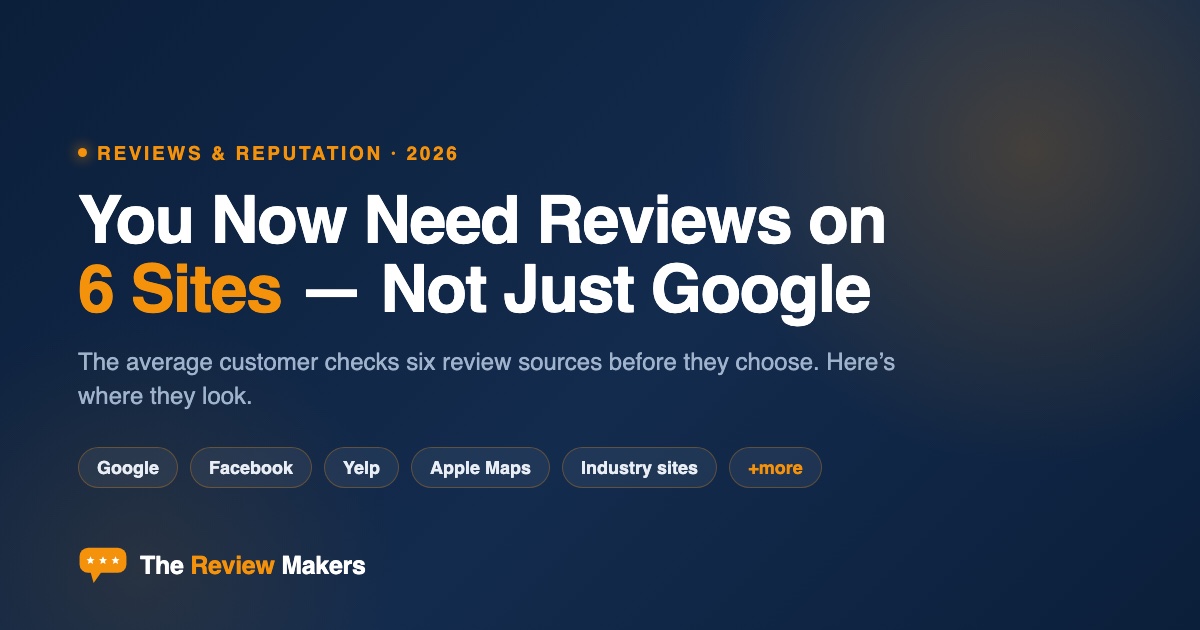
Short version. Your customers don’t stop at Google anymore. In 2026 the average shopper checks six different review sites before choosing a local business — Google, then Facebook, [Yelp](https://thereviewmakers.com/yelp-review-management), Apple Maps and an industry platform for a second opinion. If your reviews look great on Google but thin or stale everywhere else, you’re losing people in the cross-check.
Picture how people actually decide now. They Google you and see 4.7 stars — good. But before they call, they tap over to Facebook, glance at Yelp, maybe check Apple Maps in the car, and if you’re a dentist or contractor, they look you up on Healthgrades or [Houzz](https://thereviewmakers.com/houzz-review-management). At every one of those stops, they’re quietly asking: does the story hold up?
For a lot of businesses, it doesn’t — not because they’re bad, but because they poured everything into Google and left every other profile empty. And an empty profile reads as a red flag.
Google is the front door — not the whole house
Google still dominates: it hosts about 73% of all online reviews, and it’s almost always where the search begins. But “begins” is the key word. The 2026 Local Consumer Review Survey found the average consumer now consults six review sources before deciding, and 41% say they “always” read reviews when browsing — up sharply from 29% a year earlier.
So a strong Google rating gets you onto the shortlist. What happens next — on Facebook, Yelp, Apple Maps and industry sites — decides whether you make the sale.
People don’t trust one perfect profile. They trust the same good story told in five different places.
— The Review Makers
The 2026 cross-check, step by step
Here’s the pattern researchers keep seeing in how buyers verify a business:
- Google — the first impression and star rating.
- Facebook (49%) — a “are they a real, active business” second opinion.
- Yelp (44%) — a tougher, more detailed gut-check, especially for restaurants and services.
- Apple Maps (27%) — increasingly the default for iPhone users searching on the go.
- Industry platforms — Healthgrades for doctors, Houzz for home pros, Angi for contractors, [Tripadvisor](https://thereviewmakers.com/tripadvisor-review-management) for hospitality, BBB for trust-sensitive services.
Miss one of these and you don’t just lose that platform — you create a gap that makes a cautious buyer wonder what else is missing.
What a multi-platform presence actually requires
The goal isn’t to be everywhere for its own sake — it’s to be credible everywhere your customers look. That means:
- Claim and complete the profiles that matter for your industry. Google and Facebook for everyone; then the two or three platforms your specific customers actually check.
- Keep reviews flowing on more than one site. A steady trickle of recent reviews on each platform beats a big pile on one and nothing elsewhere — recency is a trust signal on every site.
- Respond everywhere, not just on Google. Replies show the business is active and attentive. Our free Review Response Generator makes it fast to reply well across platforms.
- Keep your name, address and phone identical everywhere. Inconsistent details quietly erode both trust and local-search ranking.
- Show your proof on your own site. Surface your ratings from multiple platforms with a live badge — build one free with our Reviews Badge Generator.
Our honest take
When we audit a business that’s “doing everything right” but still losing deals, the culprit is almost always the same: a great Google profile surrounded by empty or abandoned ones. The fix isn’t glamorous — claim the right platforms, keep a few genuine reviews coming in on each, and reply to them. Do that and you win the cross-check that your competitors are quietly failing.
You don’t need to be on all forty review sites. You need to be undeniable on the six your customers actually open.