Short version. AI answers now appear on roughly 87% of business-related searches, and most of those searches end without a click. The businesses that still win are the ones the AI names in its answer. Getting cited comes down to four things: letting the AI crawlers in, adding clear structured data, keeping a strong recent review rating, and answering real questions plainly. Here's how to do it.
Last month I watched a friend look for a plumber. She typed “why is my water heater leaking from the bottom” into Google, read the AI answer at the top, and then — without scrolling, without clicking a single blue link — asked a follow-up: “who fixes this near me in [Charlotte](https://thereviewmakers.com/reputation-management-charlotte-nc)?” Google named three companies. She called the first one.
Notice what didn’t happen. She never visited a website. She never compared ten listings. The AI made a shortlist of three, and being on that shortlist was the entire ballgame. That little moment is the whole story of search in 2026 — and if your business isn’t showing up inside those AI answers, you’re increasingly invisible, no matter how good your old SEO used to be.
The number that should worry every local business
Here’s the stat that reframes everything: Google’s AI Overviews appeared on 86.7% of business-intent searches in April 2026 — up from 56.9% a year earlier. In twelve months, AI answers went from “sometimes” to “almost always” for the exact searches that bring you customers.
At the same time, the way people search has fractured. ChatGPT now serves around 900 million people a week. Gartner projects traditional search volume will fall about 25% this year. And the majority of searches now end without a single click to any website.
That “zero-click” phrase gets thrown around a lot, so let me translate it into plain business terms: the customer got their answer on the results page itself. Your website traffic can fall while your visibility — the thing that actually drives calls — depends entirely on whether the AI mentioned you.
But here’s the twist nobody expected
You’d assume all of this is bad news. It mostly is — unless you get cited. Because the people who do come through AI are worth more: AI-referred visitors to US retail sites converted 42% better than non-AI traffic in March 2026.
That makes sense when you think about it. If ChatGPT recommends you by name, you arrive pre-vetted. The AI already did the “is this business any good?” work and decided you were the answer. That’s a warmer lead than someone idly scrolling a list of ten.
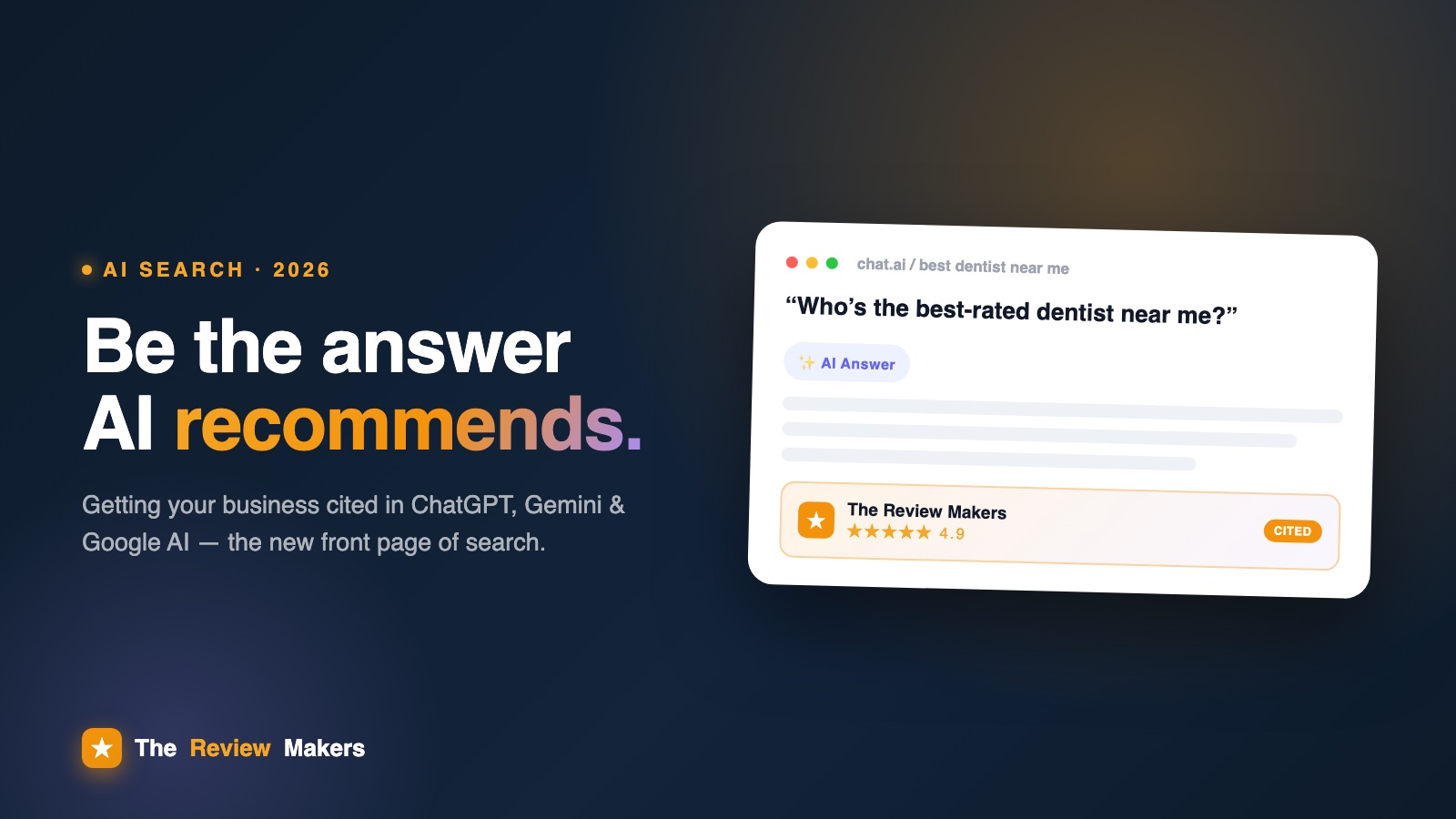
So the goal has quietly changed. It’s no longer “rank #1.” It’s be the business the AI names. The industry calls this [Generative Engine Optimization](https://thereviewmakers.com/generative-engine-optimization) (GEO) — structuring your online presence so AI platforms can find, trust, and cite you.
The goal isn’t to rank #1 anymore. It’s to be the business the AI names.
— The Review Makers
Why the AI picks some businesses and ignores others
After auditing a lot of local profiles, the pattern is consistent. AI engines don’t “rank” you the way old Google did — they assemble an answer from sources they can understand and trust. A few things decide whether you make the cut:
- The machine has to understand what you are. AI leans heavily on structured data (schema markup) and consistent business information. If your site doesn’t clearly state — in a format machines read — that you’re a dentist in [Austin](https://thereviewmakers.com/reputation-management-austin-tx) with these services, hours, and rating, the AI has to guess. It usually guesses someone else.
- Your reviews are doing double duty now. Review count, recency, and rating aren’t just for humans anymore. AI engines cross-reference review platforms to decide who to recommend. A business at 4.8★ with fresh reviews is a safer thing for an AI to name than one at 3.9★ with reviews from 2023.
- You answer real questions, plainly. AI answers are built from content that answers a question in the first breath — not content that warms up for three paragraphs. Clear FAQ sections get pulled into AI responses far more often than fluffy “ultimate guide” padding.
- You’re allowed in the door. This one shocks people: a lot of sites accidentally block the AI crawlers (GPTBot, ClaudeBot, PerplexityBot, Google-Extended) in their robots.txt. If you block the bot, you literally cannot be cited. It’s the digital equivalent of locking your front door and wondering why no one visits.
A practical GEO checklist you can start this week
None of this requires a rebuild. Here’s the order I’d actually do it in:
- Check your robots.txt for accidental AI-crawler blocks. Our free AI Visibility Checker does this in ten seconds and shows exactly which AI engines can and can’t see you.
- Add LocalBusiness + Review + FAQ schema to your key pages so machines understand your business, ratings, and answers. Our Schema Generator produces valid code you can paste in.
- Get your Google rating to 4.5★+ and keep reviews recent. In 2026, 31% of consumers only use businesses rated 4.5★ or higher — nearly double from 17% a year earlier. AI mirrors that bias.
- Write plain-language FAQs that answer the exact questions customers ask before buying — one clear question, one clear answer.
- Keep your name, address, and phone identical everywhere. Inconsistency makes the AI unsure it’s the same business, and unsure businesses don’t get cited.
The mistake most agencies are making right now
Here’s our honest opinion, and it’s a little contrarian: a lot of agencies are reacting to AI search by cranking out more content. That’s exactly backwards. Google’s March 2026 spam update — the fastest in its history — specifically targeted mass AI-generated content published without human oversight.
More thin pages won’t get you cited. They’ll get you filtered. What gets cited is a clean, well-structured, genuinely helpful presence that a machine can parse and a human would actually thank you for. Depth over volume. Clarity over cleverness.
In the audits we run, the businesses that suddenly start showing up in AI answers usually didn’t add more content — they fixed three things: they unblocked the AI crawlers, added proper schema, and pushed their rating above 4.5★. The ones that stay invisible almost always have at least one of those three broken.
The bottom line
Search didn’t disappear — it moved. It moved into an answer box that names a handful of businesses and skips the rest. The businesses that win in 2026 aren’t the ones shouting the loudest; they’re the ones the AI can understand, trust, and confidently recommend.
The good news? Most of your local competitors have no idea this shift is happening. That’s the window. Get your structured data right, your reviews strong and recent, your doors open to the crawlers — and you become the obvious answer while everyone else is still optimizing for a results page people barely look at anymore.