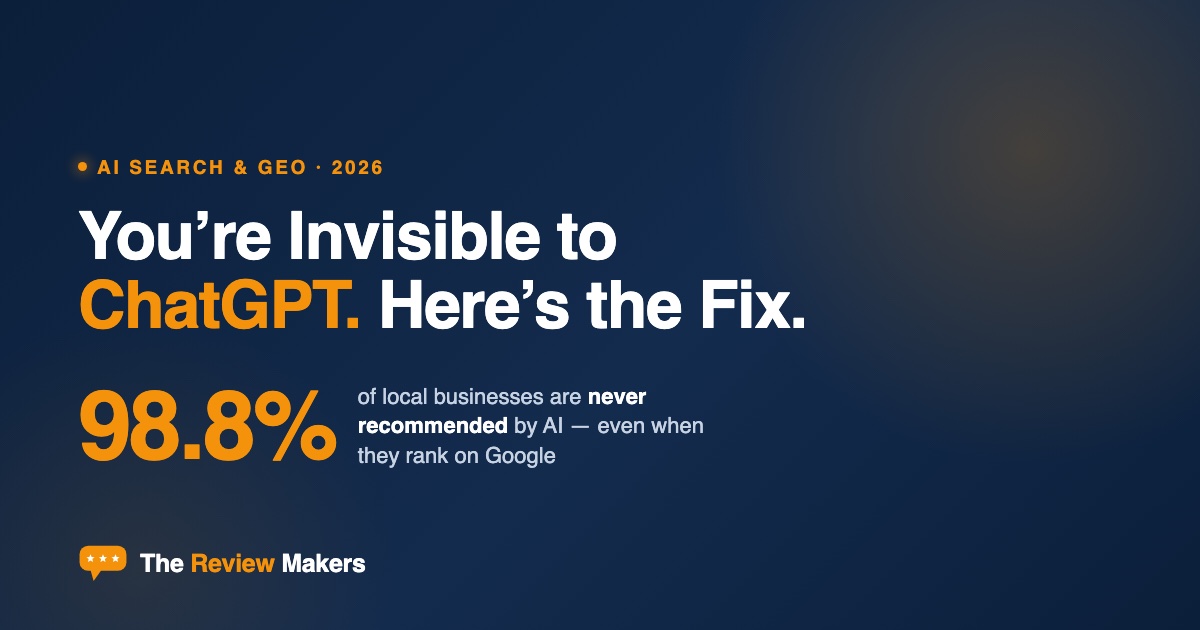
Short version. ChatGPT recommends only about 1.2% of local business locations — which means 98.8% are effectively invisible when someone asks an AI for a recommendation. Ranking on Google page one doesn’t save you: 77% of page-one businesses are invisible in ChatGPT. The fix isn’t more blog posts. It’s structured data, a complete [Google Business Profile](https://thereviewmakers.com/gbp-grader), and third-party mentions — the exact signals AI engines actually pull from.
Here’s a test you can run in thirty seconds. Open ChatGPT and ask it to recommend the best business in your category and city — “best emergency plumber in [Tampa](https://thereviewmakers.com/reputation-management-tampa-fl),” “top family dentist in [Raleigh](https://thereviewmakers.com/reputation-management-raleigh-nc).” Then look at the names it gives back. If yours isn’t one of them, you’ve just watched a customer get handed to a competitor, and you never even appeared in the running.
This is the quiet shift almost no one has adjusted to yet. Search didn’t just move to AI — the rules of who gets shown moved with it.
Why “we rank on Google” no longer protects you
For a decade, the goal was simple: get to page one. But AI search doesn’t read the results page the way you do. It assembles an answer from sources it trusts, and those sources aren’t chosen by your Google ranking. That’s why 77% of page-one businesses never surface in ChatGPT — and why AI local visibility is estimated to be up to 30× harder to earn than a traditional local ranking.
The uncomfortable truth: your beautiful, fast, page-one website might be a source AI has literally never learned to trust. Not because it’s bad — because it’s missing the specific signals AI engines look for.
Ranking on Google tells you customers can find you. AI visibility tells you whether a machine will recommend you. In 2026, those are two different games.
— The Review Makers
Where AI actually gets its local answers
When an AI recommends a local business, its citations come from a surprisingly predictable mix. For local queries, roughly:
- 42% from Google Business Profile — your GBP is the single biggest source AI pulls from.
- 28% from directories — industry listings, local directories, and roundups.
- 17% from your own website — important, but a minority of the picture.
Notice what that means: the majority of what AI “knows” about you is written and hosted somewhere other than your site. That’s why third-party validation drives 85% of AI citations. When ChatGPT names a plumber, it’s usually leaning on a comparison post, a directory, or a review platform — not the plumber’s homepage.
The fix: five moves that make you citable
The good news is that the gap is wide open — almost no one has done this yet, so the effort compounds fast. Here’s the order we work in:
- Add structured data (schema) to your site. Most business websites have zero JSON-LD markup, and that single gap often explains AI invisibility on its own. Businesses with proper schema see 45% higher AI citation rates. Start with LocalBusiness and FAQ schema — you can generate both free with our Schema Markup Generator.
- Use FAQ schema specifically. Pages with FAQ markup are 2.8× more likely to be cited in AI answers, because they hand the engine clean, quotable question-and-answer pairs.
- Complete and optimize your Google Business Profile. It’s ~42% of your local AI citations. Fill every field, keep it active, and get consistent reviews. Check yours with our GBP Grader.
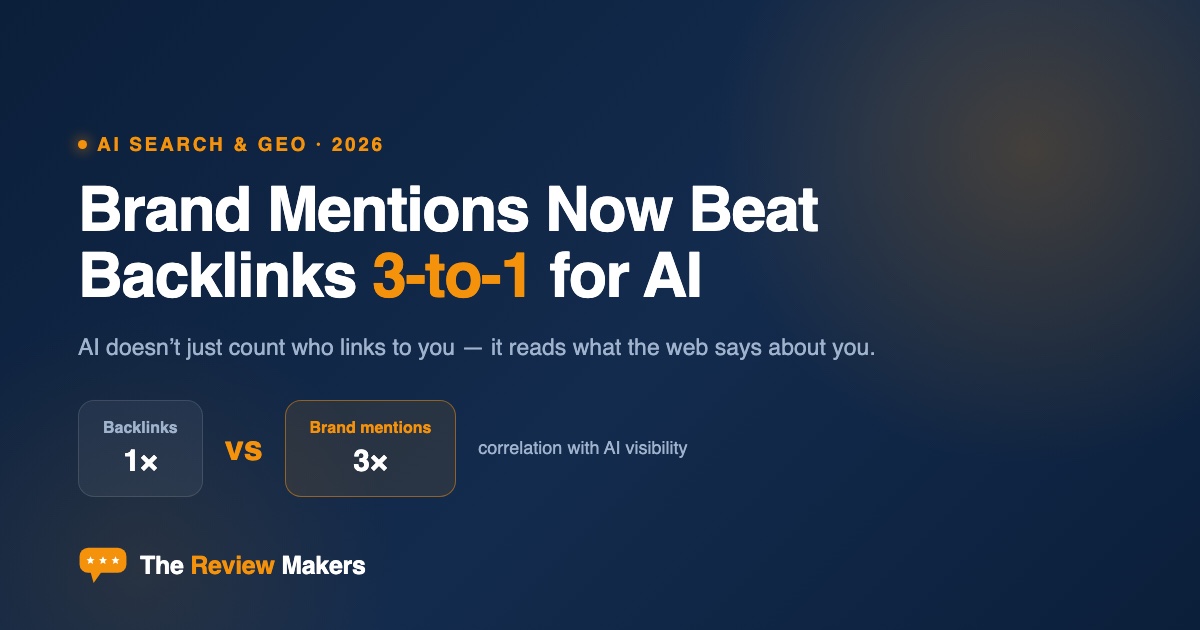
- Earn third-party mentions. Get listed in reputable directories and industry roundups, and build genuine brand mentions across the web — the signal that correlates with AI visibility far more than backlinks.
- Publish genuinely useful, in-depth content. Long-form, expert content performs best for ChatGPT citations; AI Mode starts seriously considering pages at around 2,300+ words. Depth and clarity beat keyword-stuffing every time.
Our honest take
Every audit we run tells the same story: the businesses missing from AI answers rarely have a quality problem — they have a legibility problem. Their site is invisible to machines, their Google Business Profile is half-finished, and nobody credible has mentioned them anywhere an AI can find. Fix those three things and you’re suddenly ahead of 98.8% of your market, while your competitors are still tweaking meta titles.
This won’t stay a wide-open opportunity forever. The businesses that build AI legibility now are the ones that will be the default answer for years — because once an engine learns to trust and cite you, that advantage compounds. Want the full framework? See our [Generative Engine Optimization](https://thereviewmakers.com/generative-engine-optimization) approach.