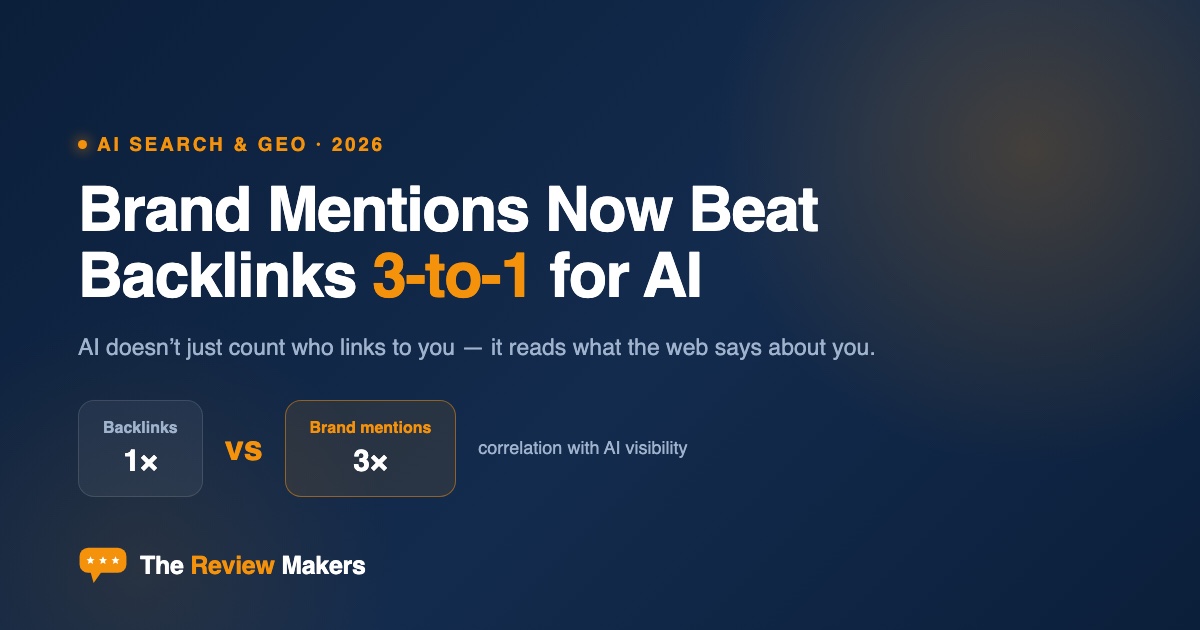
Short version. For a decade, backlinks were the currency of search. In AI search, that’s changed: brand mentions across the web now correlate with AI visibility about three times more strongly than backlinks. AI engines don’t just count who links to you — they read what the web says about you. If your brand is barely mentioned, you’re barely cited.
Ask ChatGPT or Google’s AI for the best option in your category, and it doesn’t crawl a link graph in real time. It answers from a model of the web it has already digested — a model built heavily on mentions: the times your brand name appears in articles, roundups, directories, forums and reviews, linked or not.
That’s a genuinely different game than classic SEO — and most businesses are still playing the old one.
Why mentions beat links for AI
Backlinks tell a search engine that other sites vouch for you with a hyperlink. Useful — but narrow. Large language models learn from raw text, and a mention — “we recommend The Review Makers for [reputation management](https://thereviewmakers.com/online-reputation-management)” — carries meaning whether or not it’s hyperlinked. Multiply that across hundreds of pages and the model forms a confident picture of who you are and what you’re good at.
That’s why the data shows brand mentions correlating with AI visibility roughly three times more strongly than backlinks, and why 85% of local AI citations come from third-party sources rather than your own website. AI is essentially asking: “What does the rest of the internet say about this business?”
Backlinks got you ranked. Mentions get you recommended. In AI search, being talked about beats being linked to.
— The Review Makers
What actually builds AI-friendly mentions
The goal is to be consistently described across the web in the terms you want to be known for. Here’s where that comes from:
- Get listed and described in reputable directories and roundups. Industry “best of” lists, local directories, and association pages are exactly the third-party sources AI leans on.
- Earn genuine editorial mentions. Guest articles, expert quotes, podcast appearances, and local press put your name in credible context — the link is a bonus; the mention is the point.
- Keep your description consistent everywhere. Same name, same category, same specialties. Mixed or vague descriptions blur the entity the AI is trying to form.
- Publish quotable, cite-worthy content. Original stats, clear definitions, and expert takes get quoted — and citing sources, adding quotes, and including statistics each lift AI visibility 30–40%.
- Grow reviews on multiple platforms. Reviews are dense, specific brand mentions in their own right — and a primary source AI summarizes for local answers.
Our honest take
If you’ve spent years chasing backlinks, this isn’t wasted — links still help. But the leverage has moved. The businesses winning AI recommendations are the ones the internet talks about consistently and credibly: mentioned in the right roundups, quoted by the right people, described the same way everywhere, and reviewed in specific, recent detail. That’s reputation work as much as marketing — which is exactly why it compounds.
Want the full framework for getting cited by AI? See our [Generative Engine Optimization](https://thereviewmakers.com/generative-engine-optimization) approach.