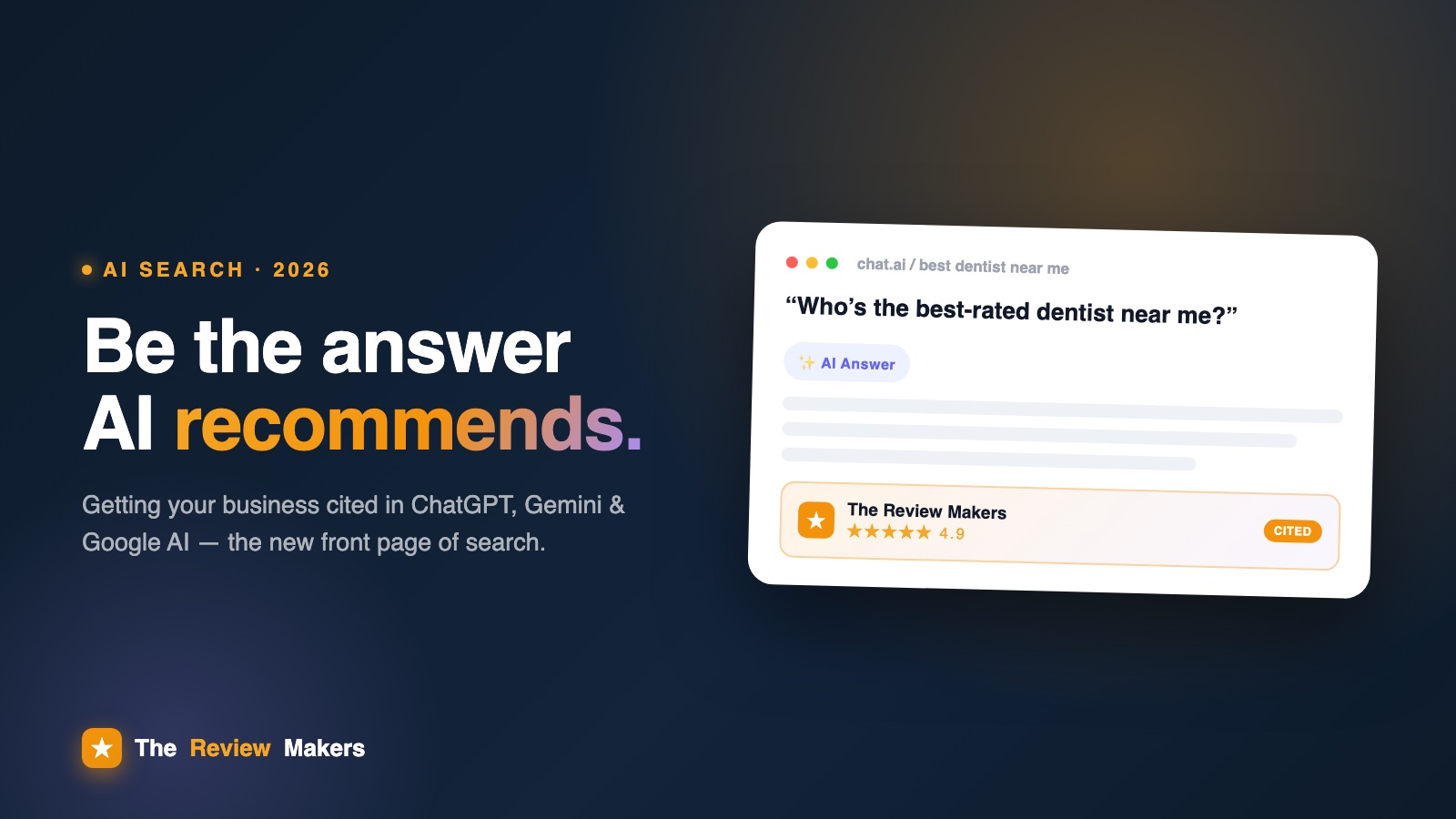
TL;DR. We submitted 100 variations of "best dentist near me" to ChatGPT, Google Gemini and Perplexity across 25 US cities. Out of 4,300 individual practice mentions surfaced, only 12% earned an actual citation back to the practice's website or [Google Business Profile](https://thereviewmakers.com/gbp-grader). The rest were unattributed paragraphs that didn't drive a single click.
If you're a practice owner who thinks ranking on Google Maps is enough, the AI search era says otherwise. Here's what the cited 12% are doing differently.
Why we ran this study
Dental practices are a near-perfect test case for AI local search — high-intent buyers, geographic specificity, mature Google Business Profile ecosystem. If anybody should be visible in AI Overviews, it's a five-star practice in a city. Most aren't.
We picked 25 US cities (4 in each major region plus a handful of secondary markets), ran four query variations per city ("best dentist near me", "best family dentist [city]", "top-rated dentist [city]", "emergency dentist [city]"), and captured the answers across three AI engines on five different days.
The 12% pattern: what cited practices share
The 516 practices that earned at least one citation shared a clear technical and content fingerprint:
- A Google Business Profile with a complete services list, a 90%+ photo completeness score, and a Q&A section the practice actively responds to (not just patients asking).
- A practice website with at least one long-form FAQ page (the words "frequently asked questions" + 10+ Q&A items), LocalBusiness or Dentist schema, and an address marked up consistently across the site.
- At least 80 [Google reviews](https://thereviewmakers.com/google-review-management) with a 4.6★ minimum — not the highest in town necessarily, but high enough to be in the credible band.
- A HealthGrades, Yelp or Zocdoc profile that AI engines can cross-reference against the practice site.
What didn't matter much: paid Google Ads spend, total domain authority, social-media activity. The cited practices weren't the biggest — they were the most structurally readable.
Where 88% of practices fail
The 3,800 uncited practice mentions almost all fell into one of three failure modes:
- No FAQ content. 71% of uncited practices had no Q&A content on their site. AI engines had nothing to quote.
- Inconsistent NAP (name/address/phone) across directories. 53% had at least one major directory listing with the wrong address or phone — enough to make the engine hesitate to cite.
- Empty or auto-generated GBP Q&A. Patients ask, nobody from the practice ever answers. AI engines treat that as a low-trust signal.
The 7-step fix
- Audit your GBP Q&A. Answer every patient question yourself. Add 8–10 questions you wish patients would ask, then answer those too.
- Build a dedicated FAQ page on your site with 15+ questions. Mark it up with FAQPage schema.
- Standardise NAP. Use the same exact format on your site, GBP, Yelp, HealthGrades, Zocdoc, and your state dental association directory.
- Add Dentist schema to your homepage and contact page — including
openingHours,acceptedInsurance, andavailableService. - Hit 80 Google reviews minimum. Use a structured request flow — see our dental review service for HIPAA-compliant scripts.
- Get cited on one credible third-party site — local press, dental association directory, or a credentialing site like the ADA Find-A-Dentist.
- Re-run the AI query test monthly. You'll see your name move into the cited band by month 3 in most cases.
The 25 cities — and why market size changed everything
We deliberately spread the test across four tiers: four major metros (Chicago, Houston, Phoenix, Philadelphia), eight mid-size cities, eight secondary markets, and five small towns. The pattern that jumped out wasn't about the practices — it was about competition density. In small towns, a practice with 60 reviews and a complete profile won citations almost every time, because the engine had few credible options to choose from. In Houston, the same profile was invisible; you needed 250+ reviews and third-party corroboration just to enter the consideration set.
Practically, that means a practice in a secondary market has a far cheaper path to AI visibility than one fighting in a top-10 metro. If you're in a smaller city, the window is open right now — most of your competitors haven't noticed it exists.
Run this test on your own practice in 20 minutes
You don't need our dataset to see where you stand. Here's the exact process we use:
- Open ChatGPT, Gemini and Perplexity in three tabs (logged out, or in a private window).
- Ask each: "best dentist in [your city]", "top-rated family dentist [your city]", and "emergency dentist near [your neighbourhood]".
- Screenshot every answer. Note whether your practice is (a) cited with a link, (b) mentioned by name, or (c) absent.
- Repeat the same three queries one week later — answers drift, and one capture isn't enough.
If you're absent across all three after two rounds, you're in the 88%. The good news: the seven fixes in this article are the same ones that moved practices into the cited 12% within a quarter.
"The cited practices weren't the biggest — they were the most structurally readable."
— From the study findings